To attract new dental patients, build a 5-layer system: Google Business Profile, reputation (reviews), a mobile-first website conversion layer, high-intent paid search, and compounding local content. Track every layer by CAC and lifetime value so growth stays predictable.
Key Takeaways
- One-third of Americans haven’t seen a dentist in over a year: that’s not a gap in the market, it’s your next hundred patients
- Most practices ignore their Google Business Profile: it’s the cheapest patient channel you’re not using, and then they wonder why their ad spend isn’t converting
- Referrals still matter, but they don’t close anymore: patients validate every recommendation online before they ever pick up the phone
- If your site isn’t built for mobile booking, you’re losing appointments you already earned: 60% of dental bookings happen on a phone
- Chasing new patients while ignoring lifetime value is a treadmill: you run harder every month just to stay in the same place
- The practices that sell at 8-10x aren’t lucky: they built patient acquisition into the infrastructure of the business, not the marketing budget
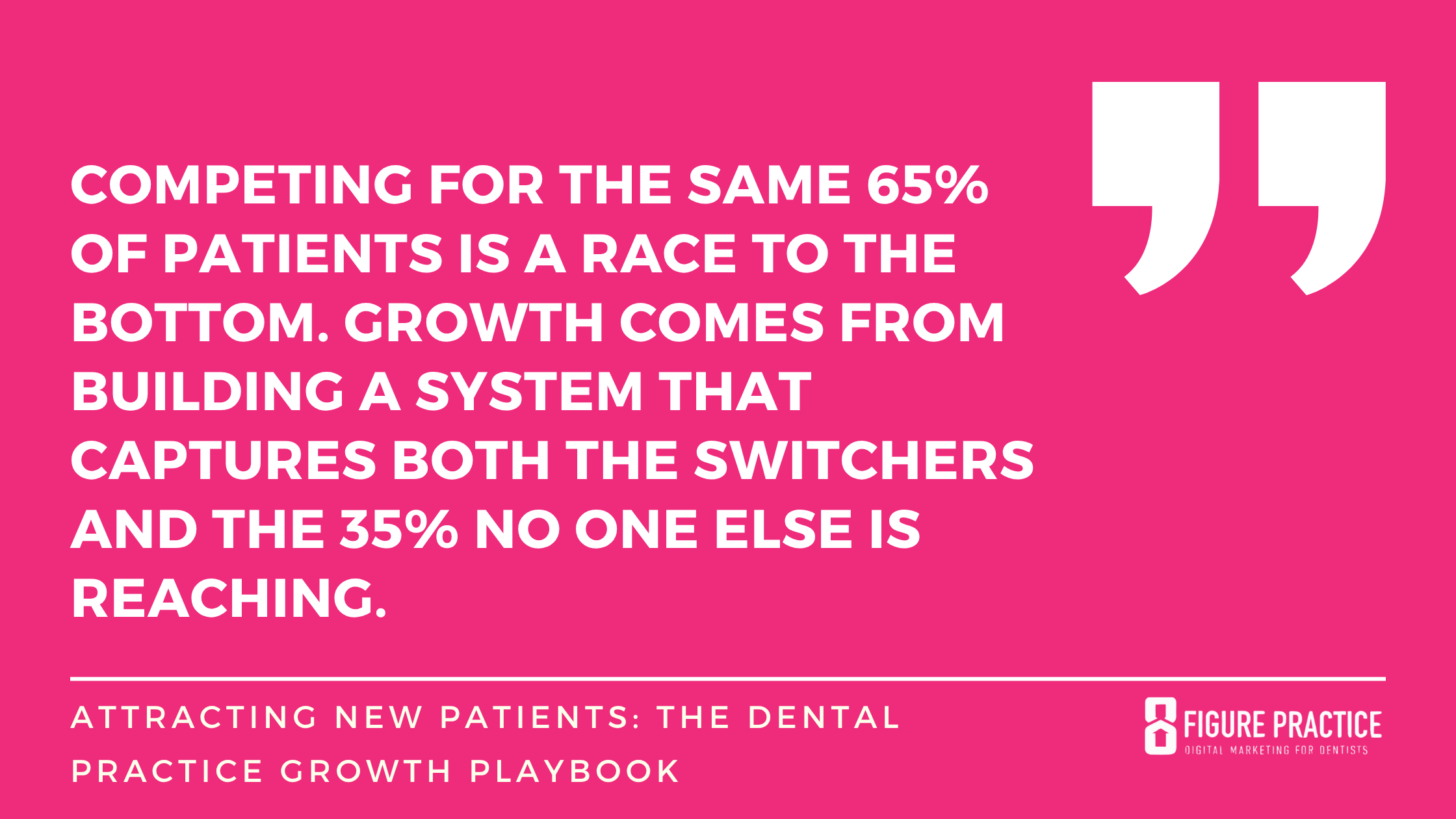
Roughly 1 in 3 Americans is not seeing a dentist regularly. According to CDC/NCHS FastStats on dental visits, only 65.5% of U.S. adults had a dental exam or cleaning in the past year. Most practices respond to that statistic by competing harder for the same 65% who already go to the dentist somewhere, fighting over the same insured, already-aware patient pool while the larger opportunity sits untouched. Your growth strategy should be built to win both: (1) switchers already in-market and (2) the 35% who haven’t been seen anywhere in 12 months.
At Eight Figure Practice, our playbook is built around a repeatable patient acquisition engine grounded in the right financial logic: every patient you bring in should be evaluated through the lens of lifetime value, not just today’s hygiene appointment. The practices that scale and sell for premium multiples understand that distinction.
Jump to:
Every layer you build makes the next one stronger. Here’s how to put them together.
Build Your Digital Foundation Before Everything Else
Google Business Profile is the highest-leverage, lowest-cost acquisition channel available to a dental practice, and most owners are leaving it half-built while paying for clicks.
Before you spend a dollar on paid ads or a minute on social content, get your GBP right. When a prospective patient searches “dentist near me” or “family dentist in [city],” Google serves a Map Pack: the 3 local listings that appear above organic results, with stars, photos, hours, and a click-to-call button. Showing up in the local 3-pack on high-intent searches outperforms most paid campaigns. The traffic is warmer, the intent is higher, and your patient acquisition cost on that channel is effectively zero beyond the time to optimize it.
The foundation of that ranking is NAP consistency. Your name, address, and phone number must be identical across every directory, citation, and listing on the web: Google Business Profile, Yelp, Healthgrades, your website footer, and everywhere else. A single inconsistency signals unreliability to Google’s local algorithm and quietly suppresses your Map Pack visibility.
Beyond NAP, photos move the needle in a measurable way. Zocdoc data shows that offices with even 1-3 photos received 2x more bookings than those with none. A fully optimized GBP includes a complete service list, accurate hours, a keyword-informed description, responses to recent reviews, and a consistent stream of current photos: interior, team, and before/after where appropriate. Pair that profile with strong dental SEO services and you have an organic search presence that generates high-value patient inquiries without a cost-per-click attached.
> GBP Optimization Checklist (10 minutes)
>
> * [ ] Set primary category to “Dentist” (add secondary: “Cosmetic Dentist,” “Dental Clinic”)
>
> * [ ] List all services offered (cleanings, implants, Invisalign, and emergency)
>
> * [ ] Write keyword-rich description including city name and key services (750 chars)
>
> * [ ] Add appointment booking URL
>
> * [ ] Set accurate hours including holiday hours
>
> * [ ] Seed Q&A with 5-8 common patient questions and answers
>
> * [ ] Upload fresh photos weekly (interior, team, and before/after)
>
> * [ ] Reply to every review within 48 hours
>
> * [ ] Publish one GBP post per week
>
> * [ ] Verify NAP matches website footer and all directories
>
> * [ ] Add UTM tracking to your booking URL
Most practices skip this step and go straight to paid ads. Fix your digital foundation first, then pour fuel on it. Once that foundation is in place, reviews become the force multiplier that converts searchers into booked patients.
Make Reviews Your Primary Patient Acquisition Channel
Most dentists think reviews are about reputation. They’re not. Reviews are how patients find you. Healthcare ratings are the #1 factor in consumer research, and even word-of-mouth referrals get validated online before anyone picks up the phone.
Most practices treat reviews as reputation management: something to monitor, respond to occasionally, and hope stays positive. That framing leaves patients on the table. Reviews are now an active acquisition channel, and the data makes the case plainly.
Press Ganey found ratings and reviews of providers are the #1 factor during the research phase, ahead of referrals. Even patients who receive a direct referral from their physician or a friend don’t take it at face value: 83.5% still go online to validate the recommendation before booking. The referral opens the door. Your reviews decide whether they walk through it.
The floor for consideration is 4.0 stars. RepuGen’s 2025 patient survey found 70% of patients require a minimum 4-star rating before considering a provider, 57.3% want to see 6 to 10 or more reviews before trusting a practice, and 59.48% prefer providers who respond to reviews. No reviews isn’t neutral: it reads as a red flag. Google is the primary platform patients use during their research. Own that platform first before worrying about anything else.
Volume is the other variable practices underestimate. Zocdoc’s booking data shows providers with 10 to 29 reviews received 3x more bookings than those with only 1 to 9. A high average rating with low volume signals an inactive practice. You need both. And once reviews are coming in, respond to every one. That 59.48% preference for responsive providers is a free conversion lever most practices ignore.
Building review volume requires a system. Use the SOP below as a clinical protocol: it runs every time, for every patient.
> Review Request SOP: 5 Steps
>
> 1. When to ask: Same day as the appointment, within 2 hours of checkout
> 2. Who triggers it: Front desk staff or automated practice management system
> 3. Exact SMS copy: “Hi [Name], thanks for visiting [Practice]! Would you take 60 seconds to leave us a Google review? [short link] Your feedback helps other patients find great care.”
> 4. QR code at checkout: Display on the front desk tablet or a printed card. Label it “Leave us a review” with the Google logo.
> 5. Weekly reply cadence: Every Monday, respond to all reviews from the prior week. A reply takes 2 minutes and signals an active, engaged practice.
Eight Figure Practice clients who move from 8 reviews to 30+ consistently see more booked appointments and lower acquisition costs across every channel. Review velocity is one of the highest-ROI patient acquisition strategies you can run. And once a patient’s convinced by what they read, your website has about 10 seconds to close the deal.
Convert the Traffic You’re Already Getting
Traffic means nothing if your site can’t close.
Your website is the conversion layer for every other channel you run. SEO brings searchers. Reviews build trust. Paid ads drive clicks. But if your website doesn’t convert that traffic into booked appointments, every dollar you’ve spent on those channels leaks out the bottom.
According to Zocdoc’s 2024 booking data, 60% of dental appointments are booked via mobile device. If your site isn’t optimized for mobile, with fast load times, thumb-friendly navigation, and a booking button that doesn’t require zooming in, you’re losing more than half your prospects before they ever reach out. This isn’t a design preference. It’s a revenue problem.
Patients expect online booking now. It’s not a premium feature anymore. Healthgrades data shows 55% of patients would consider switching dentists just to get it. Your competitors already have it, and they’re using that gap against you.
Simplicity is the mechanism. The booking process should take under 60 seconds. Every additional form field drops completion rates.
> High-Converting Dental Website Checklist
>
> * [ ] Sticky “Book Appointment” button visible on every scroll position
>
> * [ ] Click-to-call phone number above the fold
>
> * [ ] Short intake form: name, phone, and preferred appointment time (3 fields max)
>
> * [ ] Insurance field optional, not required
>
> * [ ] Single-step booking flow (no multi-page forms)
>
> * [ ] Confirmation text sent immediately after submission
>
> * [ ] “Call now” fallback prominently displayed for patients who prefer phone
A high-converting dental website design gets the basics right: fast load times, a phone number and booking CTA above the fold, a new patient special that’s impossible to miss, and service navigation that doesn’t make people hunt around. No friction between landing and booking.
Smile Dailey is a good example. Their site is mobile-optimized, leads with a booking CTA and new patient offer, and keeps navigation clean enough that nothing gets in the patient’s way. When conversion is the actual priority, that’s what it looks like.
Get the conversion layer working first. Then paid search multiplies every dollar you put in.
Capture High-Intent Patients With Paid Search
Type “dentist near me” or “dental implants [city]” into Google and you’re not looking for ideas. You’ve already decided to book. Paid search puts your practice in that exact moment, visible to patients who are ready to act right now.
That’s the fundamental difference between paid search and every other channel. There’s no interruption, no scroll-stop, no brand awareness play. It’s just you, the patient, and the exact moment they’re looking for what you offer.
According to Eight Figure Practice’s published benchmarks, drawn from their own internal campaign data, the target is a $150 average patient acquisition cost via paid search. Hold every campaign accountable to that number. With average new patient revenue exceeding $2,000, a $150 CAC is not a cost. It is leverage.
What makes dental PPC perform starts with ad account structure. Geographic targeting is not a setting you toggle on; it is the foundation of how campaigns are built.
- Target within 5 to 10 miles of each practice location, or define specific ZIP clusters that match your patient demographics.
- Exclude low-value or low-density areas where conversion rates drop.
- Apply distance-based bid adjustments so bids increase as searchers get closer to your office.
Structure separate campaigns by service line and geography: implants in downtown ZIP codes run differently than family dentistry campaigns targeting suburban ZIP clusters. Keyword matching follows the same logic. High-value service searches (implants, Invisalign, and cosmetic dentistry) get their own campaigns, not a shared budget. Aggressive negative keyword lists filter out low-intent traffic before it costs you money. Ad extensions showing your phone number and a direct booking link reduce friction between the click and the call. Google Ads for dentists works because the intent is already there. Your job is to not get in the way of it.
Retargeting turns warm traffic into booked appointments at a fraction of the cost of cold outreach. Visitors who did not book on their first visit already know your name. A well-placed retargeting ad brings them back. Practices running paid and organic together consistently see lower overall CAC than those relying on either channel alone. SEO and GBP build long-term authority while paid captures immediate intent, and that long-term content engine is what makes growth sustainable after campaigns end.
Build the Long-Game Patient Acquisition Engine
Content marketing is how you build organic traffic that compounds. A well-written implant page keeps pulling in patient inquiries months or years after you published it, at zero cost per click.
Someone searching “dental implants Austin” at 11pm isn’t browsing. They’ve decided. They’re just picking who gets the case. If you’re not ranking, you’re not on the shortlist. Ads disappear when the budget does. Organic doesn’t.
That’s the real difference between content and paid search. A well-optimized post you publish this month can pull in leads three years from now. It compounds, building topical authority, climbing rankings, and driving high-value patient inquiries without an ongoing cost per click. Paid campaigns rent attention. Content owns it.
Most practices treat blogging like a checkbox: post once, forget it. The ones scaling toward an exit treat it like infrastructure. The Eight Figure Practice content framework treats each of these as infrastructure posts: “dental implants [city],” “emergency dentist [city],” and “best dentist for families [city],” content built to intercept patients before they’ve picked up the phone, before they’ve chosen anyone.
How AI Answers Change Dental Discovery
The practices we talk to are often still operating like it’s 2022.
Google’s AI-generated answers don’t just pull from your website. They assemble responses from review signals, GBP profile completeness, directory consistency, and structured FAQ content, then surface a synthesized answer before the user clicks anything. Your practice either gets cited in that answer or it doesn’t exist in that channel.
Three things drive AI citations: a complete, accurate Google Business Profile; consistent NAP data across every directory; and FAQ pages with proper schema markup. These don’t function as separate tactics you can mix and match. They operate as a single signal. Inconsistent directory listings drag down a strong GBP. No schema means your FAQs stay invisible no matter how good the content is. The signal is unified, and it either holds together or it doesn’t.
The practices that figure this out now, before their competitors do, are going to own the AI layer in their markets. That’s not a small advantage.
Start with the content that actually moves production numbers:
- City + service pages: Pair each core service (implants, Invisalign, and emergency dentistry) with every city or neighborhood you serve
- Procedure cornerstone guides: Deep, authoritative pages on your highest-value procedures covering candidacy, process, outcomes, and cost
- FAQ pages: Answer the questions patients are already searching around cost, candidacy, recovery, and financing
- Provider pages: Individual provider profiles with credentials, photos, patient reviews, and trust signals
- Schema markup: Location schema and FAQ schema on every relevant page so search engines and AI systems can parse and cite your content
These aren’t just traffic plays. They’re the foundation of a lead generation system for dentists that doesn’t reset to zero every time ad spend drops.
For Scale to Sale practices, the math is straightforward. Organic search visibility is an owned asset that shows up when a buyer evaluates your practice. Combined with a full-service dental marketing strategy, content becomes one of the most defensible growth assets you can build.
> A practice with ranking blog posts and consistent organic traffic is worth more than one entirely dependent on paid ads.
Frequently Asked Questions
How long does it take to attract new patients to a dental practice?
Paid search can put the phone ringing inside your first week. That part is fast. The slower burn is GBP and reviews, which take three to six months to really compound, but those are also the channels that keep producing without a media spend behind them. What actually controls the timeline isn’t your budget; it’s how consistently the system runs month over month.
What is the best marketing channel for attracting dental patients?
The practices with the lowest CAC aren’t winning because they found the magic channel. They’re winning because they stopped rotating tactics and built a system. GBP captures the “dentist near me” volume, paid search picks off patients who are ready to book today, and reviews convert the click into a call. Pull one leg out and the whole thing gets wobbly.
How many Google reviews does a dental practice need to compete?
Two hundred reviews with a 4.7-plus rating is where you start consistently owning the local pack. Below that, you’re competing; above that, you’re setting the standard. But total count is a vanity metric if your last review is from eight months ago. Google and patients both treat velocity as a trust signal, so five to ten fresh reviews per month matters more than the number you banked two years ago.
How much should a dental practice spend on patient acquisition?
Five to eight percent of gross revenue is a reasonable baseline. On a $1.5M practice, that’s $75K to $120K across your acquisition channels for the year. The number that actually matters more than what you spend is what comes back: EFP clients targeting a 38:1 return are measuring every dollar against the lifetime value it generates, not just the cost of the appointment. Budget conversations get a lot cleaner when you’re working from LTV, not CPL.
What is a good cost per new patient for a dental practice?
Under $150 CAC is achievable with a dialed-in digital system, but most practices running Google Ads without real landing pages, call tracking, or a converted GBP profile are quietly watching that number creep past $400 without realizing it. The bigger mistake is looking at blended CAC and thinking it tells you something useful. Break it out by channel and you’ll almost always find one that’s subsidizing another one that isn’t working.
Build a Patient Acquisition System That Scales
A dental practice with a functioning acquisition system brings in new patients predictably, without depending on any single channel or referral source.
Most practices don’t have an acquisition problem. They have a dependency problem. One referral source dries up, one campaign pauses, and the schedule gaps appear immediately. That’s not a system. That’s a streak.
Building a real system means your GBP, reviews, website, paid campaigns, and content all do work simultaneously, each one reinforcing the others. You can pause any single piece and the machine doesn’t stop. When everything’s firing together, patient acquisition stops feeling like hustle and starts showing up in your metrics as a predictable, compounding asset.
That’s what practice owners building toward a premium exit or market dominance actually have in common: they’re not chasing tactics. They’ve built infrastructure. Whether you’re on the Scale to Sale path or going Independent and In Demand, the foundation is identical. System first, tactics second.
Eight Figure Practice works exclusively with dental practice owners. Not med spas, not general small businesses, not anyone else. Some are building their marketing foundation for the first time. Others are further along and thinking seriously about what a profitable exit actually requires. Either way, the focus is the same: infrastructure that performs under real growth conditions.
If you’re not sure where your growth engine is leaking, a strategy session will show you. You’ll get a full audit covering GBP performance, review velocity, website conversion rate, and CAC by channel, plus a 90-day action plan built around the actual gaps in your practice. Clients average a 38:1 return on their marketing investment. That’s not a rounding error. Book a strategy session or reach out directly through the contact page and tell Eight Figure Practice where you’re stuck.