AEO, or Answer Engine Optimization, is the practice of structuring your dental website’s content so AI tools can extract and cite it when a patient asks a relevant question. Voice search for dentists has fundamentally changed: patients aren’t just asking Siri or Alexa where to find a dentist anymore. They’re getting a single, cited answer from ChatGPT, Google AI Overviews, or Perplexity, and one practice name is attached to it.
Key Takeaways
- AEO gets dental practices cited in AI Overviews, ChatGPT, Perplexity, and voice results, not just ranked on Google
- Voice search has shifted from assistant queries to AI answer engines that cite specific sources
- Structured FAQ content and direct-answer formatting are the core signals AI tools use to extract citations
- Google Business Profile (GBP) completeness affects both local and AI search visibility
- Every dental website needs a specific content structure to be AI-extractable
- AEO and traditional SEO work together; practices that ignore AEO lose patients to competitors who don’t
- Eight Figure Practice clients use AEO as part of a patient acquisition system built for measurable growth
Why Voice Search for Dentists Has Evolved Into an Answer Engine Problem
Voice search used to mean ranking for “dentist near me” and hoping Siri read your listing. That model is obsolete.
A practice owner in Phoenix reached out to Eight Figure Practice after watching a competitor begin appearing in AI answer results for “sedation dentist” queries in their city. The competitor hadn’t changed their Google Ads budget or their SEO vendor. They’d changed their content structure. That’s the shift this post is about.
The broader pattern moved in three stages: typed search, then voice queries, then AI-generated answers, and that last stage changes everything for your practice. According to DemandSage’s Voice Search Statistics, 76% of voice searches are local or near-me queries, and 8.4 billion voice assistants are active globally. Those patients aren’t getting a list of results anymore. When someone asks ChatGPT, “Find me a dentist in Austin who takes Delta Dental,” they get one answer. One practice name. One citation.
That’s not a ranking. It’s a citation. AI tools don’t pull citations the same way Google ranks pages. The content that gets cited is structured, authoritative, and formatted to answer questions directly. The practices winning in this environment aren’t just dominating Google. They’re being extracted as the answer before a patient ever clicks anything.
What AEO Actually Means for Dental Practices
AEO is distinct from SEO in one critical way: SEO earns clicks; AEO earns citations. Both matter for high-value patient acquisition, and neither replaces the other.
Three platforms are actively citing dental practices right now: Google AI Overviews, ChatGPT Search, and Perplexity. Each evaluates content differently, but all three reward the same signals: clearly structured, question-answering content written with authority. GEO (Generative Engine Optimization) is the broader umbrella term for this discipline. AEO for dental clinics is how you apply it specifically to patient acquisition.
Practically, this means your website needs content that AI tools can extract as a direct answer. That includes FAQ sections, service pages written in question-and-answer format, complete NAP (name, address, and phone number) data, and a fully optimized GBP. AEO is one layer of a complete patient acquisition system; for the full framework, see the dental patient acquisition growth playbook.
If you’ve already covered the basics of local search, read our guide on voice search for dentists. AEO is what comes next.
The Content Structure That Gets Dental Practices Cited
AI tools don’t read your website the way a human does. They extract specific chunks of text, and the practices that get cited are the ones that structure content to make extraction easy.
Three patterns drive AI citation consistently.
Direct-answer paragraphs under every heading
AI pulls the first 2-3 sentences beneath a heading. Those sentences need to answer the implied question immediately. No warm-up. No context-setting. An implant page that opens a section with “Dental implants are a permanent solution for missing teeth. Most patients complete treatment in 3-6 months, with final restoration placed after the implant integrates with the jawbone” gives an AI tool exactly what it needs to cite your practice. One that opens with “Many of our patients come to us wondering about their options” gets skipped.
Every service page section, every FAQ answer, every blog intro: direct answer first, context second. This single structural change, applied consistently, is what separates practices that get extracted from practices that get ignored.
Question-format headings with tight answers
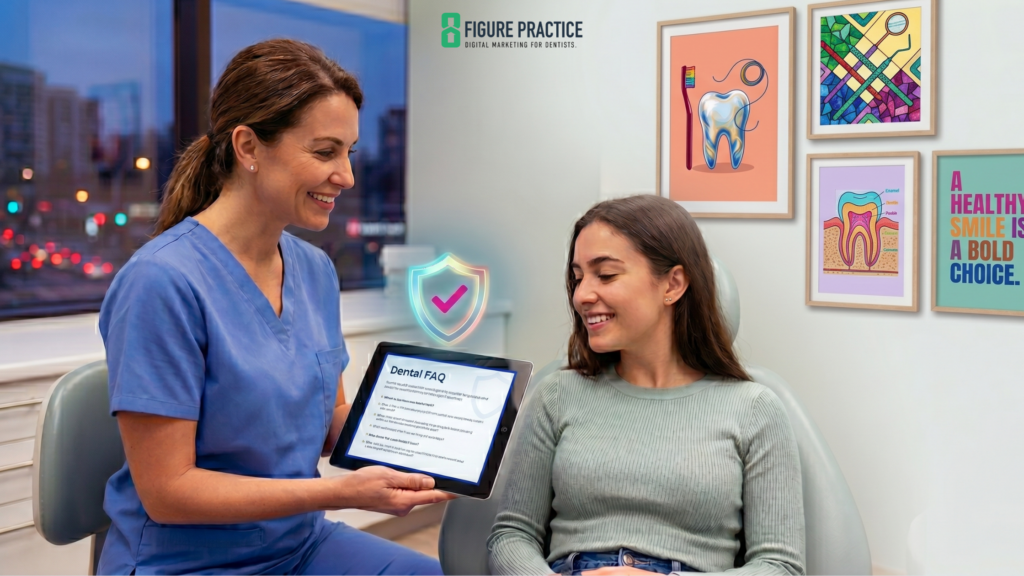
HubSpot research found the average ChatGPT prompt is 23 words, compared to 3.37 words for traditional search. Patients aren’t typing “dental implants.” They’re asking “How long does it take to get dental implants if I’m missing multiple teeth?” Your content needs to match that. Structure FAQ content with the question as the H3 heading and 2-3 direct sentences underneath.
This isn’t a standalone FAQ page buried in your site navigation. It’s structured Q&A embedded throughout your service pages and blog posts. A new patient page with H3s like “What should I bring to my first dental appointment?” followed by a 3-sentence answer outperforms a wall of paragraph text every time. Build it into every major service page using a proven dental FAQ strategy.
Numbered and bulleted lists for process content
When patients ask “how to” questions, AI tools pull structured lists. Format every procedural explanation, every prep checklist, and every step-by-step guide as a list. A paragraph describing the implant process doesn’t get extracted. A numbered list of the 5 steps from consultation to final crown does.
At Eight Figure Practice, these three patterns are built into the content architecture for every client’s service pages from the start. It’s not a retrofit. Structuring content and SEO for dental websites this way from day one is what separates practices that get cited from practices that get ignored.
How to Optimize Your Google Business Profile for AI Answers
Your Google Business Profile (GBP) is the single most powerful off-site signal for AI-powered local search. When someone asks an AI tool “best dentist near me,” it pulls heavily from GBP data to construct its answer.
Start with completeness. Every field in your GBP profile needs to be filled: services, hours, photos, and a description that includes the keywords high-value patients actually search. Incomplete profiles get deprioritized, and AI tools are not going to fill in the gaps for you.
The Q&A section on your GBP is where most practices leave the most on the table. It’s easy to ignore because it feels like a secondary detail next to reviews and photos. It isn’t. AI search tools pull from this content when assembling answers about local providers, which makes it some of the highest-leverage copy on your entire profile. Fill it out yourself before patients start adding their own questions. “Do you accept new patients?”, “Do you offer same-day emergency appointments?”, “What insurances do you take?” Answer each one with specifics. That’s what gets surfaced. A GBP with 8 detailed Q&A responses outperforms one with none, even when every other signal is identical.
Reviews: build a cadence, not just a count. A practice with 200 reviews posted mostly 3 years ago ranks weaker than a practice with 80 reviews posted steadily over the last 12 months. AI tools weight recency.
NAP consistency is how AI tools cross-verify your practice actually exists. Your name, address, and phone number need to match exactly across every directory, including Yelp, Healthgrades, Zocdoc, and your own website. Discrepancies introduce doubt into the algorithm. Doubt means you don’t get cited.
GBP posts keep your profile active. Once a week is enough. Pair your GBP strategy with a strong local SEO foundation for dentists and the two compound each other’s effectiveness.
Eight Figure Practice helps dental practices build the full AEO and local SEO stack, from GBP optimization to on-site content architecture. If you want to know exactly where your practice stands, book a strategy session and get a clear picture of what’s costing you visibility.
AEO Checklist: What to Fix on Your Dental Website Right Now
Run through this list before you spend another dollar on marketing. Most practices are missing at least 6 of these 10.
> AEO Readiness Checklist for Dental Practices
>
> * GBP profile complete with services, hours, photos, and Q&A responses populated with patient-specific questions
> * NAP consistent across all directories: Yelp, Healthgrades, Zocdoc, your website, and any local citations
> * Reviews actively building with a recent posting cadence, not just a historical volume count
> * GBP posts published weekly with practice updates, promotions, or educational content
> * Service pages built for each core offering (implants, Invisalign, emergency dentistry) with a direct-answer opening paragraph
> * FAQ schema markup implemented on-site so AI tools can parse your answers as structured data
> * Each FAQ answer written as a standalone, complete sentence that directly addresses the question without requiring surrounding context
> * Page titles and meta descriptions include location-specific phrases patients actually search
> * Internal linking connects service pages to location pages and educational content, creating a crawlable topic cluster
> * Site speed and mobile performance meet Core Web Vitals thresholds; AI tools don’t cite slow, broken experiences
Questions About AEO for Dentists
Does AEO replace traditional dental SEO?
No. AEO and SEO solve different problems. SEO puts you in front of patients who are searching; AEO gets you cited when AI tools answer their questions directly. Dropping either one leaves a real gap in how new patients find you.
How long does AEO take to show results?
Faster than traditional SEO. Structural content changes can be picked up within 4 to 8 weeks. AI training cycles vary by platform, so citation frequency builds over time as your content gets indexed and referenced.
What dental pages should I optimize for AEO first?
Start with your homepage, core service pages, and your new patient FAQ. These are the pages that directly answer the questions AI tools field most often, making them the highest-leverage starting point for AEO implementation. In practice, we typically find that a dental implant page and an emergency dentistry page move first because those are high-intent queries patients ask AI tools directly. Optimize those two before you touch anything else.
Do I need a separate AEO strategy for ChatGPT vs. Google AI Overviews?
The same foundational content works across platforms. Google AI Overviews lean more heavily on organic ranking signals, so your existing SEO work carries weight there. ChatGPT and Perplexity weight structured answers and citation frequency more heavily, which is where schema markup and authoritative content architecture move the needle.
Can a dental practice do AEO without a marketing agency?
Some elements are DIY-able, but a complete AEO implementation requires structured content, schema markup, GBP optimization, and ongoing monitoring. That’s a full-stack system. Eight Figure Practice builds this as part of an integrated patient acquisition stack, not as a standalone add-on.
Turn AEO Into a Patient Acquisition Engine
Voice search for dentists has moved beyond Google rankings. Practices that own AI citation today are building the patient pipeline that makes them worth acquiring tomorrow.
AEO isn’t another marketing tactic to test. It’s the infrastructure that puts your practice in front of high-value patients before they ever open a search results page. When someone asks ChatGPT which dental implant practice to trust, or when Google’s AI summarizes the best cosmetic dentist in their city, the practices that show up aren’t there by accident. They built systems that made them the credible, citable answer.
This is core to the Scale to Sale strategy. Practice valuation reflects the predictability of your patient pipeline, not just your current revenue. Practices with strong AEO presence and consistent inbound volume from AI referrals carry more predictable growth, and that predictability is what acquirers pay a premium for.
If you want to increase patient volume while building an asset worth acquiring, AEO is a non-negotiable piece of that system.
Book a strategy session with Eight Figure Practice to find out where your practice stands in AI search today, and what it takes to become the practice AI recommends first.