
A dental practice FAQ page builds patient trust by answering the cost, pain, and judgment fears that stop anxious patients from calling. Done right, it resolves objections before a prospect ever picks up the phone.
Key Takeaways
- Nearly three-quarters of U.S. adults report some fear of the dentist, and 41% skip appointments entirely because of that anxiety.
- Before choosing a provider, 94% of patients research online first; your website is the first conversation you have with every prospective patient.
- A well-built FAQ page is a trust mechanism, not a content filler: it intercepts objections at the moment of highest doubt.
- The four objection categories a dental FAQ must address are cost transparency, pain expectations, judgment fears, and process uncertainty.
- FAQ pages structured around conversational questions are increasingly cited by AI search tools and featured in Google’s direct-answer results.
- Practices that resolve pre-booking objections online convert more site visitors into scheduled appointments without adding front-desk call volume.
- Eight Figure Practice builds these trust systems as part of a broader patient acquisition strategy tied to measurable revenue outcomes.
Why 72% of Patients Research Your Practice Before They Ever Call
Before that first phone call ever happens, most prospective patients spend time online looking for a practice they can actually trust, not just one that showed up in their search results.
A September 2025 JADA study found that 72.6% of U.S. adults report some fear of the dentist, and 41% skip appointments specifically because of that anxiety. These are not edge cases. They are the majority of the adults in your service area, and they are searching your website for evidence that your practice is safe before they commit to a call.
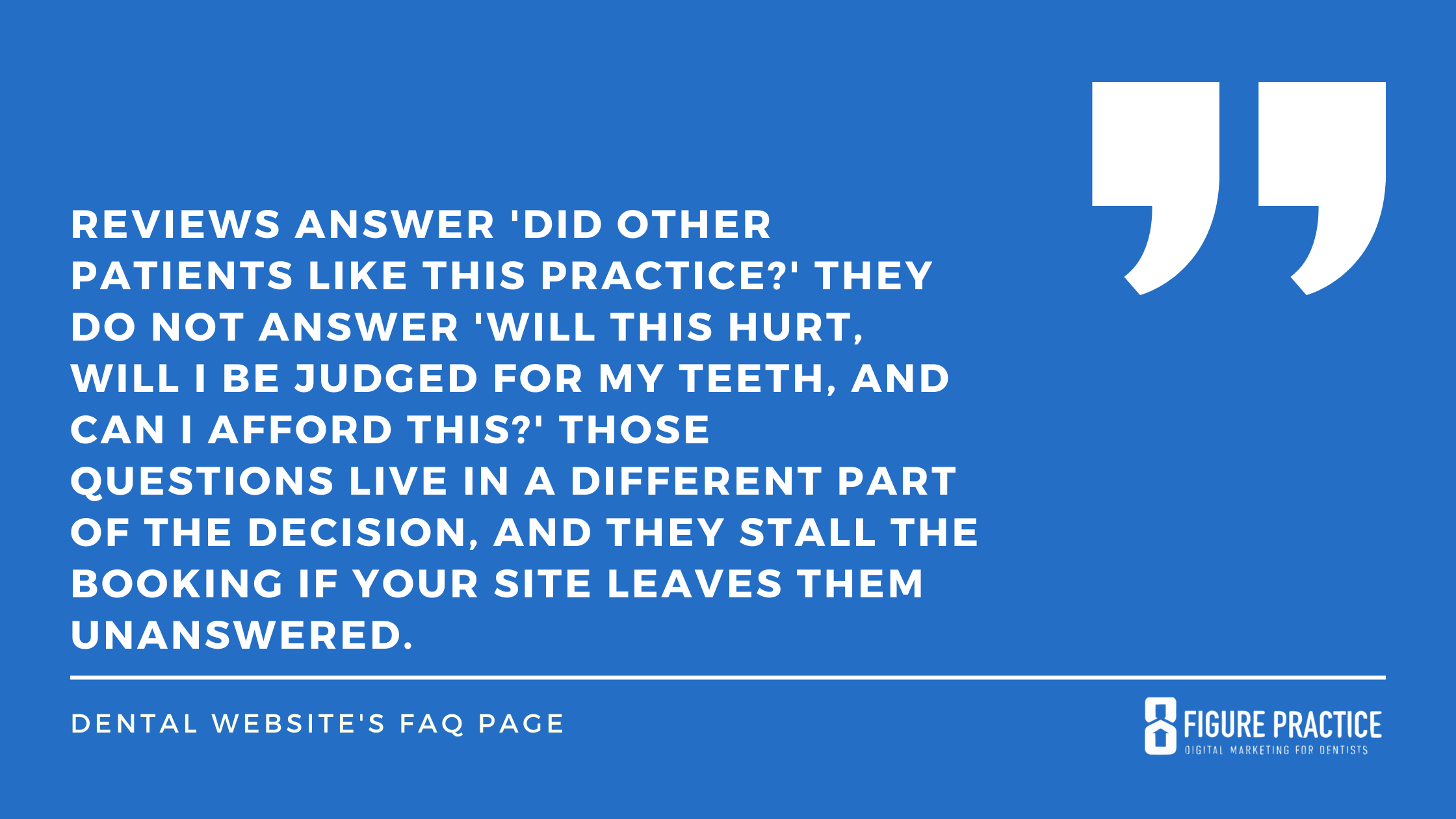
The research behavior backs this up. According to RepuGen’s 2025 patient research, 94% of patients look up a provider online before deciding, and 73.28% factor in online reviews when selecting a provider. Reviews matter, and so does every other signal on your site. But reviews answer “did other patients like this practice?” They do not answer “will this hurt, will I be judged for my teeth, and can I afford this?” Those questions live in a different part of the decision, and they stall the booking if your site leaves them unanswered.
That is the gap most practices miss. Dental websites cover office environment, meet-the-team bios, and service listings. Almost none directly address the psychological mechanism driving pre-booking research: fear. A patient who lands on your site at 10 p.m., anxious and uncertain, is not looking for a photo gallery. They are looking for answers to specific, uncomfortable questions.
For a full picture of the trust signals that matter, patient trust strategies for dental websites covers the broader framework. The FAQ page is where the highest-anxiety research moment either converts or exits. Eight Figure Practice treats it as a revenue asset, not an afterthought.
The Real Questions Patients Ask Themselves Before Booking a Dentist
Before a prospective patient calls your front desk, they have already had a conversation with themselves. You were not in the room for it, but the outcome determines whether they book or bounce.
Three objections run on a loop in that internal monologue.
The first is anxiety about pain and judgment. 72.6% of U.S. adults report fear of the dentist, and 41% skip appointments because of it. The patient landing on your site is not just wondering if the procedure will hurt. They are wondering if you will make them feel ashamed for the years they avoided coming in. That fear is often stronger than the pain itself.
The second is cost uncertainty. “What if they find something I cannot afford to fix?” is a question patients almost never say out loud, but it stops bookings cold. They do not know what a cleaning costs versus an implant. They do not know if you take their insurance. They do not know if they will walk in for a routine visit and leave with a treatment plan they cannot fund.
The third is procedure uncertainty. Root canal. Bone graft. Implant. These words carry weight for patients who have no frame of reference for what actually happens. How long does it take? Will I be numb the whole time? Can I drive myself home? The unknown is uncomfortable, and uncomfortable patients delay.
Your website is where these objections either get resolved or go unaddressed. Most practice sites let them go unaddressed.
How Your FAQ Page Answers the Objections That Kill Appointments
A well-built FAQ page does one thing: it answers the questions patients are already asking, before they have to ask you. That is not a small thing. It is the difference between a patient who books and one who closes the tab.
Match your FAQ structure to the three objection categories above. Address anxiety directly: explain your comfort protocols, your no-judgment policy, and what a first visit actually looks like. Address cost: list your payment options, financing availability, and how insurance works at your practice. Address procedures: give plain-language descriptions of your most common treatments, including time estimates and recovery expectations.
Patients who get those answers on your website arrive at the appointment with their guard already down. They are not walking in braced for bad news. They have already decided to trust you. That shift is concrete: informed patients are more likely to accept treatment recommendations, more likely to show up, and more likely to refer others.
Eight Figure Practice covers how to convert FAQ readers into booked appointments inside the dental patient acquisition playbook. The short version: your FAQ is not a support document. It is a pre-appointment sales conversation your practice is having at scale, around the clock, without anyone on your team lifting a finger.
FAQ Structure That Earns Patient Trust AND Gets You Cited in AI Search
FAQ structure isn’t a nice-to-have. It’s what determines whether a prospective patient books or bounces. Vague answers like “We offer a variety of payment options” don’t reassure anyone. Patients read that and assume you’re hiding something. Specificity is what builds trust, and trust is what gets you cited.
Specificity is the trust mechanism. “Our all-on-4 implants start at $24,000 per arch and include the consultation, surgery, and one year of follow-up” tells a patient exactly where they stand. “Patients report mild soreness for two to three days after a crown prep; most take over-the-counter pain relief and return to normal activities the next morning” gives them something real to hold onto. Direct, honest, complete answers are what build the confidence that books appointments.
Structure also determines whether answer engine optimization (AEO) and generative engine optimization (GEO) work in your favor. AI answer engines like ChatGPT, Google AI Overviews, and Perplexity extract content by scanning for a clear question followed by a direct, concise answer. Google AI Overviews now appear in roughly 75% of dental-related searches. When your FAQ headings are formatted as H3 questions, and the first one to two sentences directly answer those questions, you are writing in the exact format AI engines are built to extract and cite. Question-format headings are a citation structure.
For a deeper breakdown of how FAQ architecture maps to spoken queries and AI citations, the guide on voice search for dentists covers the full picture.
What a High-Trust Dental FAQ Page Includes
A high-performing FAQ page does not just answer questions. It answers the specific questions patients are actually afraid to ask. The checklist below covers the categories that build trust and give AI engines something to extract.
> * Cost transparency: Actual price ranges or “starting at” figures for your most common procedures. “Call for pricing” is a conversion killer.
>
> * Procedure timelines: Specific time estimates patients can plan around. “A crown appointment typically runs 90 minutes over two visits.”
>
> * Pain and comfort realities: Honest answers about what patients will feel, plus your sedation options and how to request them.
>
> * Insurance and payment options: Which plans you accept, what financing you offer, and how billing works for out-of-network patients.
>
> * First-visit expectations: What happens at the initial appointment, how long it takes, and what to bring.
>
> * Emergency access: Who to call after hours, how quickly you can get a patient in, and what qualifies as a dental emergency.
>
> * Post-procedure care: What patients should expect in the 24 to 72 hours after common procedures, including what is normal and what warrants a call.
Real patients don’t browse dental websites for fun. That search at 11 p.m. is them deciding whether you’re worth calling. Answer every question on that list directly, and you’ve earned the appointment. Leave it vague, and they’re already clicking to the next practice.
Questions Dentists Ask About Building Patient Trust Online
How often should we update our dental FAQ page?
Review your FAQ page at least quarterly. Pull new questions from patient intake forms, front desk call logs, and treatment coordinator notes every 90 days. If a question is coming up in conversations, it belongs on your page.
How long should each FAQ answer be?
Two to five sentences is the sweet spot. Long enough to actually answer the question and build confidence, short enough that a patient scanning before their appointment gets to the point fast. If an answer needs more than a paragraph, it probably belongs on a dedicated service page.
Does adding an FAQ page actually help with Google rankings?
Yes, when it is done right. FAQ content structured with schema markup can earn rich results directly in search, which puts your answers above competing links. Beyond rankings, it keeps patients on your site longer, which signals relevance to Google.
What is the difference between a FAQ page and a FAQ section on individual service pages?
Think of them as two different tools for two different moments in the decision. Your standalone FAQ page covers the practice-wide questions: costs, insurance, what to expect at a first visit. FAQ sections on individual service pages go narrower: “How long does a crown take?” or “Will Invisalign affect my speech?” You need both, because someone researching implants isn’t asking the same questions as someone who just booked a cleaning.
We already have a FAQ page. How do we know if it is building trust or just taking up space?
Check three things: time on page, form submissions or call clicks originating from that page, and whether the questions actually match what patients ask. If the page has a 20-second average session and zero conversions, it is taking up space. A working FAQ page shows up in traffic, keeps patients engaged, and moves them toward booking.
Your FAQ Page Is a Trust Asset. Build It Like One.
FAQ pages earn their place in dental marketing because patients don’t arrive at your site ready to book; they arrive carrying questions about cost, discomfort, and whether you’re the right fit. Answering those concerns in plain language, before anyone picks up the phone, is what separates a practice that converts browsers into booked appointments from one that doesn’t.
That shift matters for practice growth. Patients who get their questions answered online arrive with higher intent. They have already talked themselves into treatment. They are easier to schedule, faster to accept, and more confident in the relationship from visit one.
The practices winning high-value patients online are not the ones with the fanciest websites. They are the ones whose content resolves doubt at every stage of the decision. Your FAQ page is where that work happens.
If your current FAQ page is not driving calls and form submissions, the structure, the questions, or both need work. Start with the fundamentals in this dental FAQ page guide.
When you are ready to build a content and marketing strategy that turns your website into a patient acquisition engine, Eight Figure Practice can help. Book a strategy session with the Eight Figure Practice team and let us show you exactly where your FAQ page is leaving patients and revenue on the table.